
By the Choose Wisely Group
The garage is one of those spaces that accumulates everything over time. Tools migrate from their hooks, seasonal bins stack up in doorways, and a space that was supposed to hold two cars slowly becomes a single-file obstacle course. If you have been meaning to tackle this space for months, you are not alone. The garage is consistently one of the most deferred home projects, because it feels overwhelming before you even start.
Here is the good news: garage organization does not require a weekend-long project or an expensive overhaul. It requires a clear plan, the right storage systems, and a willingness to make decisions about what actually belongs there. Once you know what you are working with, the rest falls into place faster than you would expect.
Whether you are prepping your McLean home for the market or simply trying to reclaim square footage you have been ignoring, an organized garage pays dividends well beyond aesthetics. It adds functional storage to your home, makes daily routines smoother, and, for buyers touring a property, signals that a home has been genuinely well cared for.
Key Takeaways
- Starting with a full purge before bringing in any new storage systems gives you an accurate picture of what you actually need to organize.
- Vertical wall space and ceiling storage are the most underused square footage in the average garage.
- Grouping items by activity zone rather than category makes your garage more intuitive and easier to maintain.
- Investing in labeled, stackable containers dramatically reduces the time you spend searching for things.
- A well-organized garage can meaningfully impact how your home shows to buyers.
Start With a Purge Before You Organize Anything
The single biggest misstep people take when organizing their garage is skipping the purge. They buy shelving units, label makers, and storage bins before they have any idea what they are actually keeping. The result is an organized-looking garage that still holds three broken leaf blowers and a box of mismatched cables from 1997.
Before you touch a single shelving unit, pull everything out of the garage completely. This forces you to confront every object individually rather than shuffling items around and convincing yourself that you will deal with them later.
Once everything is out, sort it into four categories: keep, donate, trash, and relocate. Getting those items to their proper home before you start organizing gives you a much cleaner starting point.
Before you touch a single shelving unit, pull everything out of the garage completely. This forces you to confront every object individually rather than shuffling items around and convincing yourself that you will deal with them later.
Once everything is out, sort it into four categories: keep, donate, trash, and relocate. Getting those items to their proper home before you start organizing gives you a much cleaner starting point.
Questions to Ask During Your Purge
- Have you used this item in the past 12 months, and if not, is there a specific season or occasion that will realistically require it?
- Are there duplicates you can consolidate, particularly for tools, garden supplies, or sporting equipment?
- Is this item still functional, or has it been kept out of habit despite being broken or outdated?
- Could this be donated, sold, or gifted to someone who would actually use it?
- Does this item belong in the garage, or did it end up here by default?
Design Your Garage Around Activity Zones
Once you know what you are keeping, resist the urge to put everything back in whatever space is available. Instead, think about the way you actually use your garage and design zones around those activities. Most garages serve multiple purposes simultaneously: vehicle storage, lawn and garden, tools and hardware, sports gear, and seasonal overflow. Treating each of those as its own zone makes the space far more intuitive to navigate.
Activity zoning means that everything related to a specific task lives together. Your lawn and garden zone should have your mower, fertilizer, gloves, hose attachments, and pruning shears in the same area. Your automotive zone should group car wash supplies, motor oil, jumper cables, and tire pressure gauges together. When you need something, you go to one area instead of searching across the entire garage.
Proper zoning also keeps high-traffic items accessible and low-traffic items stored further away. If you grab your bike every weekend, it should be easy to reach. If you only pull out the camping gear once or twice a year, it can live on a higher shelf or in a harder-to-reach corner. The goal is to match where things live with how often you use them.
Activity zoning means that everything related to a specific task lives together. Your lawn and garden zone should have your mower, fertilizer, gloves, hose attachments, and pruning shears in the same area. Your automotive zone should group car wash supplies, motor oil, jumper cables, and tire pressure gauges together. When you need something, you go to one area instead of searching across the entire garage.
Proper zoning also keeps high-traffic items accessible and low-traffic items stored further away. If you grab your bike every weekend, it should be easy to reach. If you only pull out the camping gear once or twice a year, it can live on a higher shelf or in a harder-to-reach corner. The goal is to match where things live with how often you use them.
Tips for Setting Up Intuitive Zones
- Position the zone you use most frequently closest to the entry point you use most, whether that is the door to the house or the main garage door.
- Keep hazardous items like chemicals and sharp tools in designated locked or elevated storage.
- Use floor tape, paint, or rugs to visually delineate zones if possible.
- Allow for buffer space between zones so that one area does not merge into another over time.
- Reassess zones seasonally; what you need front-and-center in spring may look different from what you need in winter.
Make Vertical and Ceiling Space Do the Heavy Lifting
Floor space is finite, but wall and ceiling space in the average garage is almost entirely wasted. If your current storage strategy involves items piled on the floor or stacked along the walls, you are leaving a significant amount of usable square footage untouched. Shifting your thinking vertically is one of the highest-impact changes you can make.
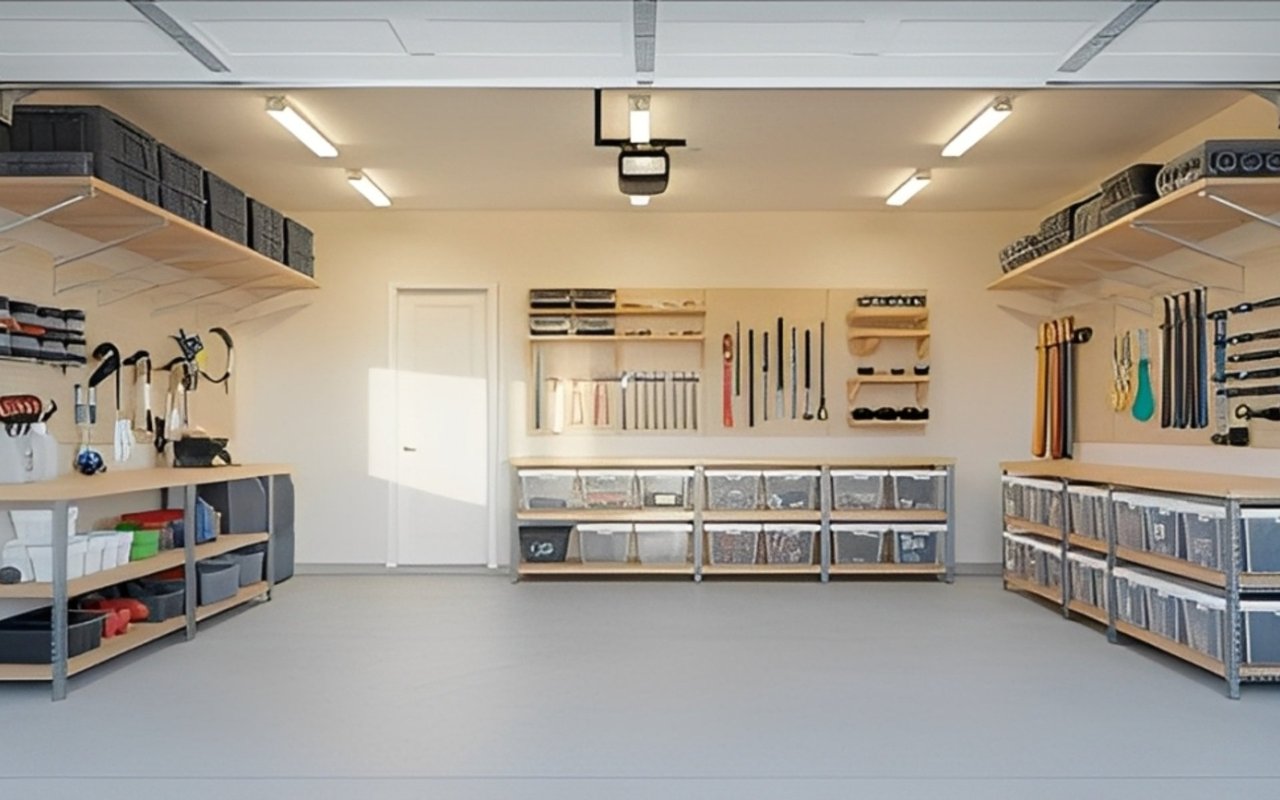
Wall-mounted shelving systems are the foundation of a functional garage. Adjustable track systems let you reconfigure shelf heights as your storage needs change. Pegboards are ideal for tools and smaller items; when everything has a designated hook, you can see at a glance what is missing. Slatwall panels offer similar versatility with a cleaner visual profile.
Ceiling-mounted storage racks are particularly well-suited for bulky, seasonal items: bins of holiday decorations, luggage, camping gear, or roof racks for vehicles. These items tend to be large and unwieldy, which is exactly why they make the floor feel so cramped. Moving them overhead frees up wall and floor space for the items you access more regularly.
Wall-mounted shelving systems are the foundation of a functional garage. Adjustable track systems let you reconfigure shelf heights as your storage needs change. Pegboards are ideal for tools and smaller items; when everything has a designated hook, you can see at a glance what is missing. Slatwall panels offer similar versatility with a cleaner visual profile.
Ceiling-mounted storage racks are particularly well-suited for bulky, seasonal items: bins of holiday decorations, luggage, camping gear, or roof racks for vehicles. These items tend to be large and unwieldy, which is exactly why they make the floor feel so cramped. Moving them overhead frees up wall and floor space for the items you access more regularly.
Best Uses for Vertical and Overhead Storage
- Bikes, kayaks, and paddleboards are excellent candidates for ceiling hoists or wall-mounted brackets that keep them off the floor entirely.
- Long-handled tools like rakes, brooms, and shovels hang most effectively on horizontal wall hooks rather than standing in a corner where they constantly tip over.
- A tall utility cabinet can consolidate smaller items, keep them dust-free, and give the garage a finished look.
- Track shelving along the perimeter maximizes every linear foot of wall space without blocking natural pathways.
Invest in the Right Containers and Labeling Systems
The wrong containers can make an organized garage feel cluttered and chaotic. The right ones make it easier to maintain the system you devise, because everything has a clear home and a clear identity.
Clear or semi-transparent bins are ideal for anything you need to identify quickly. Opaque bins work well for seasonal items you are not pulling out regularly, as long as they are labeled on multiple sides. Bins of uniform size and shape stack more efficiently and look more intentional than a mix of whatever you picked up at different stores over the years.
Label everything. This sounds obvious, but the commitment to labeling is what separates a garage that stays organized from one that devolves back to chaos within a few months. Labels do not have to be elaborate; a label maker does the job well. Apply labels on the front and the side of every container so that you can read them regardless of how they are stacked.
Clear or semi-transparent bins are ideal for anything you need to identify quickly. Opaque bins work well for seasonal items you are not pulling out regularly, as long as they are labeled on multiple sides. Bins of uniform size and shape stack more efficiently and look more intentional than a mix of whatever you picked up at different stores over the years.
Label everything. This sounds obvious, but the commitment to labeling is what separates a garage that stays organized from one that devolves back to chaos within a few months. Labels do not have to be elaborate; a label maker does the job well. Apply labels on the front and the side of every container so that you can read them regardless of how they are stacked.
Container and Labeling Best Practices
- Choose bins with lids to keep contents clean and dry, particularly for anything stored on lower shelves where moisture and pests are more likely.
- Heavy items should go in smaller bins to keep them manageable; lighter items can go in larger bins since weight is less of a concern.
- Color-coding by zone or category adds a visual layer that makes retrieval faster.
FAQs
What Should I Do With Items I Want to Donate or Sell?
Items left in your garage have a way of gradually migrating back into regular storage. Schedule a donation pickup, drop unneeded items off within a day or two, or post them for sale online.
Is It Worth Investing in a Full Garage Organization System Before Selling?
A garage that reads as functional and well-organized makes a fantastic first impression. It signals storage capacity and overall home maintenance in a way that buyers notice, even if they cannot articulate it.
Your Garage Deserves the Same Attention as the Rest of Your Home
A well-organized garage does not happen by accident. It is the result of making deliberate decisions about what you are keeping, where it lives, and what system will hold it in place. That process takes time upfront, but the payoff is a space that genuinely works for you rather than one you are constantly working around.
If you are getting ready to list and want to know what buyers are looking for right now, reach out to our team at the Choose Wisely Group. We are here to help you put your best foot forward in the McLean, VA, real estate market.
If you are getting ready to list and want to know what buyers are looking for right now, reach out to our team at the Choose Wisely Group. We are here to help you put your best foot forward in the McLean, VA, real estate market.